Red Flags for Tenant Improvement
Not every red flag means a space should be rejected. It means: stop assuming, start investigating.
Fifteen Warning Signs Worth Investigating Early
Tenant improvement projects usually look easiest before anyone opens the ceiling. The lease is signed, plans look clean, a Tenant Improvement Allowance has been negotiated — then reality begins interacting with the plan. Not every red flag means a space should be rejected. Instead, a red flag means: stop assuming, start investigating.
Eight Red Flags That Deserve Investigation
Experienced landlords, tenants, brokers and contractors recognize these patterns quickly.
“The Allowance Should Be Plenty”
TIA negotiated before realistic TI pricing exists is one of the most common red flags in commercial leasing.
Nobody Has Defined Who Pays for What
Without a responsibility matrix, gaps develop between landlord work, tenant work, and contractor work.
“The Space Is Already Built Out”
Existing improvements can create false confidence — existing does not automatically mean reusable.
Code Compliance Hasn't Been Discussed
Construction can trigger requirements that were not part of the previous configuration.
Glass Replacement & Repair
Emergency board-up, single-lite replacement, failed insulated units and frame repair on occupied commercial properties.
The Cheapest Space Requires the Most Work
Lease economics evaluated without construction economics can hide the true occupancy cost.
Nobody Has Looked Above the Ceiling
Commercial ceilings hide problems remarkably well — abandoned wiring, blocked ductwork, restrictive sprinkler mains.
Everyone Is Counting on Change Orders Being Small
Individually minor changes accumulate — and the contingency disappears faster than expected.
The Allowance Was Never the Budget
Few numbers create more false confidence than a Tenant Improvement Allowance. A landlord offers $20 or $50 per square foot, and everyone begins thinking about what can be built with the allowance. The more important question is different: what will the required project actually cost? A $500,000 allowance attached to an $850,000 build-out still leaves a $350,000 problem — never evaluate the TIA in isolation.
Responsibility Gaps and Existing-Space Assumptions
Without a clear responsibility matrix, gaps develop between landlord work, tenant work, and contractor work — watch for phrases like “I thought the landlord was doing that.” Existing improvements can also create false confidence: a second-generation office may look considerably less expensive than building from a shell, but existing does not automatically mean reusable. The correct value of existing construction is based on reuse, not simply existence.
Engineering Catching Up to a “Finished” Plan
A beautiful drawing is not automatically a construction-ready solution.
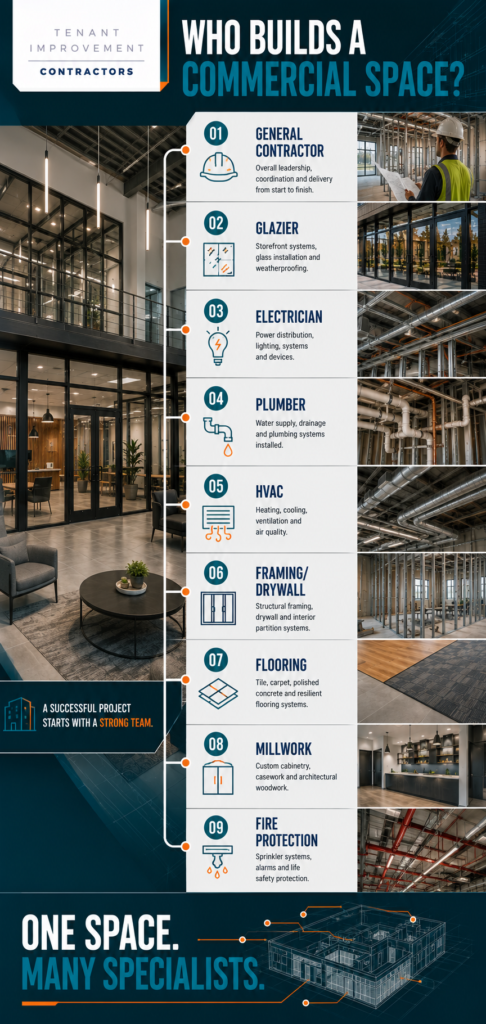
Architectural drawings can create a powerful illusion of completeness. Rooms have names, walls have dimensions, everything looks ready — then engineering begins, and mechanical, electrical, plumbing and fire protection requirements start changing the “finished” floor plan. A buildable TI requires coordination among all of those disciplines plus structure and building operations.
The Schedule Doesn't End When Construction Ends
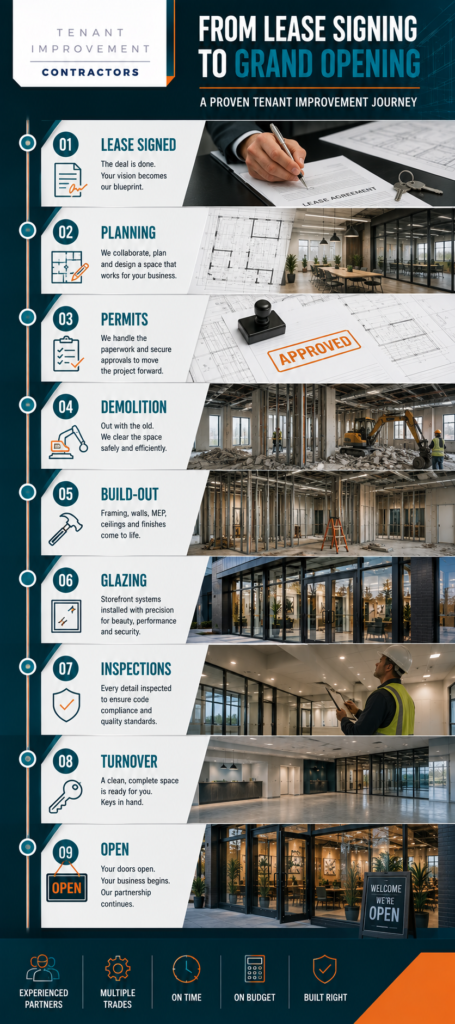
Construction completion does not necessarily equal business occupancy. Final inspections, punch-list corrections, systems testing, commissioning, furniture installation and technology setup all come after substantial completion. Opening day should not automatically be scheduled for the morning after the contractor’s completion date — transition requires time.
One Contractor Who Investigates the Red Flags First
Finding red flags early turns them into planning decisions instead of construction emergencies — which is why investigation happens before design, not after.
Existing-Condition Investigation
We look above the ceiling and behind the walls before design begins.
Realistic Pricing Early
We compare your TIA against probable construction cost before the lease is signed.
Engineering Alongside Design
MEP and fire protection are coordinated with architecture from the start, not after.
Realistic Transition Planning
We schedule inspections, punch work and commissioning — not just construction.
Bay Area Tenant Improvement Coverage
Tenant Improvement Licensed Contractors serves commercial clients throughout the San Francisco Bay Area — from San Francisco and Oakland to San Jose, the Peninsula, the East Bay and the North Bay.

Red Flags FAQs
Explore Tenant Improvement Trades, Project Types, Guides & Locations
Every build-out connects specialty trades, the type of property, the stage of the project, and where it is built. Find the page you need below.
Specialty Trades
- Tenant Improvement General Contractor
- Architectural Design, Space Planning & Permitting
- Commercial Demolition Contractors
- Commercial Concrete Contractors
- Framing, Drywall & Acoustic Ceilings
- Commercial Plumbing & Restroom Build-Outs
- Commercial Electrical & Lighting
- Commercial Lighting Contractors
- Commercial HVAC & Mechanical Modifications
- Fire Sprinklers & Life Safety Systems
- Low-Voltage & Data Cabling
- Commercial Security Systems
- Commercial Access Control Systems
- Commercial Roofing Contractors
- Storefront Glazing, Framing & Installation
- Commercial Flooring Installation
- Custom Millwork, Cabinetry & Casework
- Painting, Wall Coverings & Interior Glazing
- Commercial Elevator Contractors
- Commercial Signage Contractors
Project Types
Plan Your Project
Investigate the Red Flags Before You Sign or Build

Licensed commercial contractors for tenant improvements and build-outs in Arizona, California, Colorado, Florida, Illinois, Nevada, New York, Oregon, Texas, Utah, and Washington.
Quick Links
States We Serve
© 2026 Tenant Improvement Contractors. All rights reserved.